When you search for tactical knives or tactical accessories, you get dozens of answers. Every listing promises durability, and every brand claims its products are field-proven. If you cannot tell which blade fits a patrol shift, a security post, or a backcountry assignment, this guide gives you a way to decide.
Buyers who skip a role and restriction check often end up with a blade they cannot carry. That mistake forces a return and a reorder, and it delays your team. This article shows you how to compare tactical knives for field and duty use by role, blade style, restrictions, and order size before you spend a dollar.
Choose by role first, restrictions second, and durability third. The supplier behind this guide supports that sequence with fast quotes, bulk delivery, and trusted support.
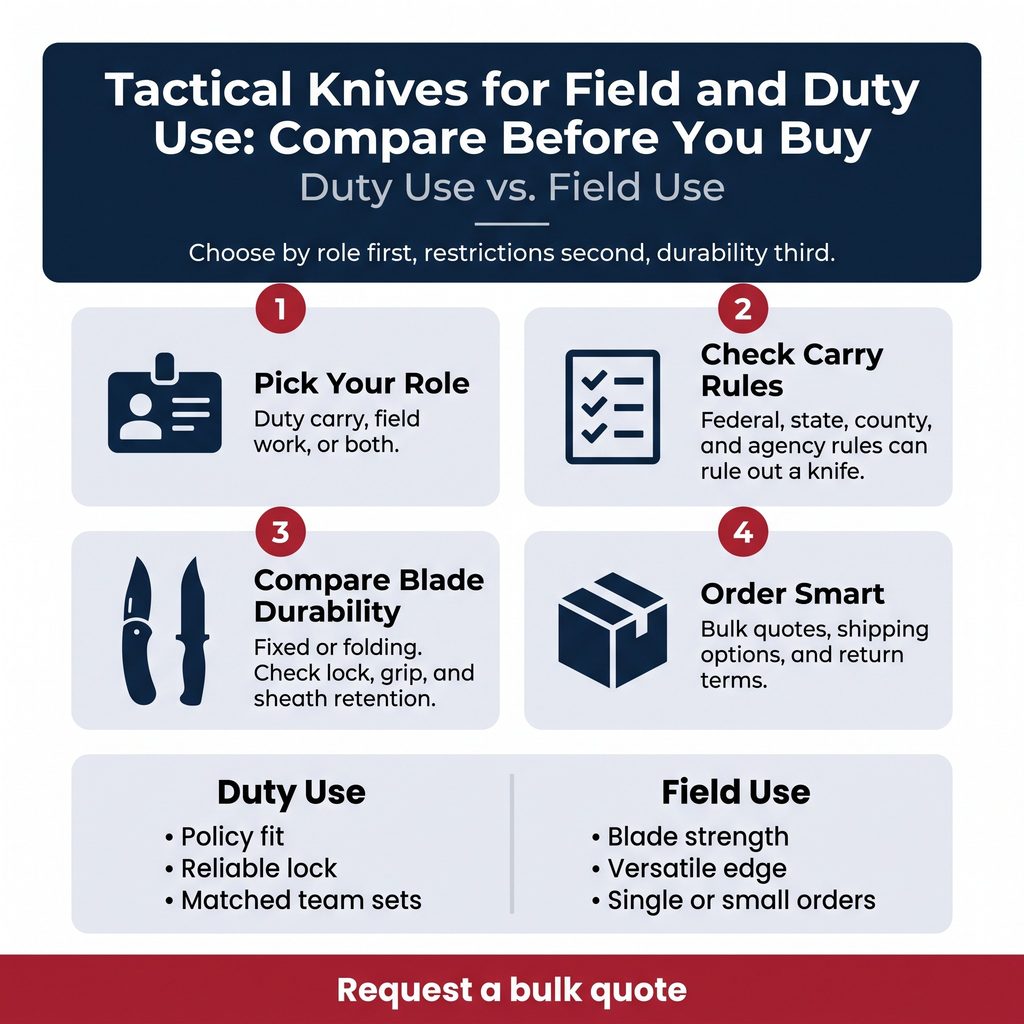
Among tactical accessories, a knife earns its place only when its design matches the user’s job. Use the two comparisons below to place your own need.
Duty Use vs. Field Use
| Criterion | Duty use | Field use |
| Typical setting | Patrol, security post, vehicle checks | Camp, wildlife patrol, outdoor work |
| Restriction risk | Higher, because agency policy and facility rules apply | Varies by land and local law |
| Durability priority | Lock reliability and sheath retention through daily wear | Blade strength under prying and heavy cutting |
| Order pattern | Matched sets through a bulk quote | Single or small orders |
Fixed Blade vs. Folding Knife
A fixed blade knife has no folding mechanism, making it suitable for demanding use, but it generally takes up more space on a belt. A folding knife carries smaller and sits flatter, but its lock becomes a part you must inspect. Choose the style that matches how long you carry it and how hard you use it.
This supplier supports buyers of tactical accessories with quote assistance, bulk-order options, and customer support, helping them shortlist suitable knives.
How do you choose the right tactical knife? Start with the role: duty carry, fieldwork, or both. Next, confirm any carry restriction at your post, facility, or jurisdiction. Then compare durability features such as blade strength, lock type, grip, and sheath retention.
Finally, confirm the quote, shipping, and return terms before you order. This sequence keeps you from buying a blade you cannot carry or use.
Durability and Reliability Criteria for Field-Proven Knives
The supplier lists durability and reliability as a core focus of its tactical equipment. Its Quality Gear promise centers on products that withstand the rigors of outdoor use.
Apply the same standard to every blade you compare. Check the lock for positive engagement, the handle for grip when wet, and the sheath or clip for retention during movement. A qualified supplier matches equipment to your actual need, so ask what the blade will cut, where you will carry it, and how often you will use it.
Screen Carry Restrictions Before You Compare Blades
Restrictions can rule out a knife before you compare steel or handle shape. Under 18 U.S.C. §930, knowingly possessing a dangerous weapon in a federal facility is generally prohibited, subject to specified exceptions and exemptions. Review the full statute and applicable facility rules before purchasing or carrying a knife.
Federal law also reaches distribution. The U.S. Government Publishing Office publishes 15 U.S.C. 1242 within a chapter on the manufacture, transportation, and distribution of switchblade knives. State, county, and agency rules differ, so check your policy first.
Then ask the informed-buyer question: does this blade match the officers, vehicles, and posts it will serve?
Buying Terms and Credentials That Lower Your Risk
Terms matter as much as steel. The supplier offers standard, expedited, and overnight shipping, and you can return an item in original condition within 30 days for a full refund. Agencies and security companies can send an RFQ and expect a team response within one to two business days.
The supplier also lists SAM registration, DUNS verification, and GSA and set-aside eligibility as its own claims. The SAM.gov registration page states that registration lets an entity bid on government contracts and assigns a unique entity ID.
The U.S. Small Business Administration states that certified service-disabled veteran-owned small businesses can compete for federal sole-source and set-aside contracts. Confirm which registrations apply to your purchase.
Suppliers of tactical accessories usually follow one of three models, and each model trades one benefit for another.
Catalog Retailers and Bundle Sellers
Catalog retailers list many knives and let you filter by brand or blade style. However, a wide selection still leaves you responsible for checking role requirements and carry restrictions. Bundle sellers package officer essentials into kits. Although a kit can save search time, a fixed bundle may not suit every role.
Government-Schedule Suppliers
Government-schedule suppliers sell through contract vehicles to agencies. The U.S. General Services Administration describes its Multiple Award Schedule as a program where federal, state, local, and tribal governments get commercial products and services at good prices.
Yes, a contract vehicle simplifies ordering, but a contract does not decide whether a blade fits your duty policy.
Two differences decide the outcome for tactical accessories buyers: how you select the blade and how you place the order.
Catalog Listing vs. Role-Based Selection
Role-based selection starts with the user, not the product page. Write down who carries the knife, where, and under which rules, then shortlist blades that fit those answers. Buyers who skip that step can end up with equipment mismatched to the officers, vehicles, or posts it serves.
The U.S. Consumer Product Safety Commission runs NEISS to collect data on consumer product-related injuries and to produce nationwide estimates. Safety managers can use its public query tool when they weigh blade styles.
Single Orders vs. Bulk Quote Process
Yes, a single-order cart works well for one buyer, but a team equipping 12 officers needs matched sets, delivery timing, and one point of contact. The supplier routes bulk requests, special quotes, and orders outside the lower 48 states through one RFQ form. List the role, quantity, and delivery location for each blade so the quote matches your roster.
Match your situation to the labels below to decide where your tactical accessories order belongs.
Best for Catalog-Only Retailers
Individual buyers who already know the exact model, have confirmed their carry rules, and want to order one blade without guidance. It also suits repeat buyers who are replacing a known item.
Best for Agency and Security Buyers
Agency, security company, and wildlife-protection buyers who must match knives to roles and restrictions, order in bulk, and want quote terms, shipping options, and return terms in writing before the purchase order goes out.
Q1. Are tactical knives legal to carry at work?
Legality depends on your location, employer, and facility. Under 18 U.S.C. 930, published by the U.S. Government Publishing Office, federal law prohibits knowingly possessing a dangerous weapon in a Federal facility. Exclusions and exemptions exist, and state and local laws differ, so verify them and your agency policy before you buy.
Q2. What is the difference between a duty knife and a field knife?
A duty knife serves daily carry on shift, so retention, a reliable lock, and policy fit matter most. A field knife serves outdoor and hard use, so building strength and edge versatility matter most. Many teams need both. Pick by the task first and the product second. Check which style the item description lists before you order.
Q3. Can this supplier quote tactical knives in bulk for my agency?
Yes. Submit the RFQ form with your role, quantity, and delivery location. Orders outside the lower 48 states and international orders use the same form.
Q4. What if my tactical knife arrives damaged?
Contact the support team for a replacement or return. Reach the team at sales@btpdusa.com or 855-741-FLAG (3524), Monday to Friday, 9:00 am to 6:00 pm EST.
Your next step for tactical accessories is a short, written role check, followed by a quote request. Doing this before you order lowers the chance of a return and keeps your team equipped on schedule.
Write down the role (duty, field, or both), the carry rules at each post, and the quantity per team. Send those details so the supplier can respond with matching options for tactical knives for field and duty use. The supplier is Veteran-Owned and SDVOB, and its Trusted Support team can help you find what you need.