
Search for a power outage emergency kit, and you get a dozen different answers. Every listing claims to be the best. If you cannot tell which kit to trust or what to compare, this article gives you a clear way to decide.
A kit chosen without considering your needs may not match your group size or the emergency you face.
The short verdict: choose a shelter-in-place kit for outages you expect to ride out at home, and a grab-and-go kit for storms that may force you to leave.
Body Telemetry and Protective Devices (BTPD) sells emergency preparedness & survival kits for both situations, and this guide shows you how to choose between them.
Choose a shelter-in-place kit when you stay home through an outage and a grab-and-go kit when you may leave. Choose both when blackouts and evacuation-level storms each threaten your household.
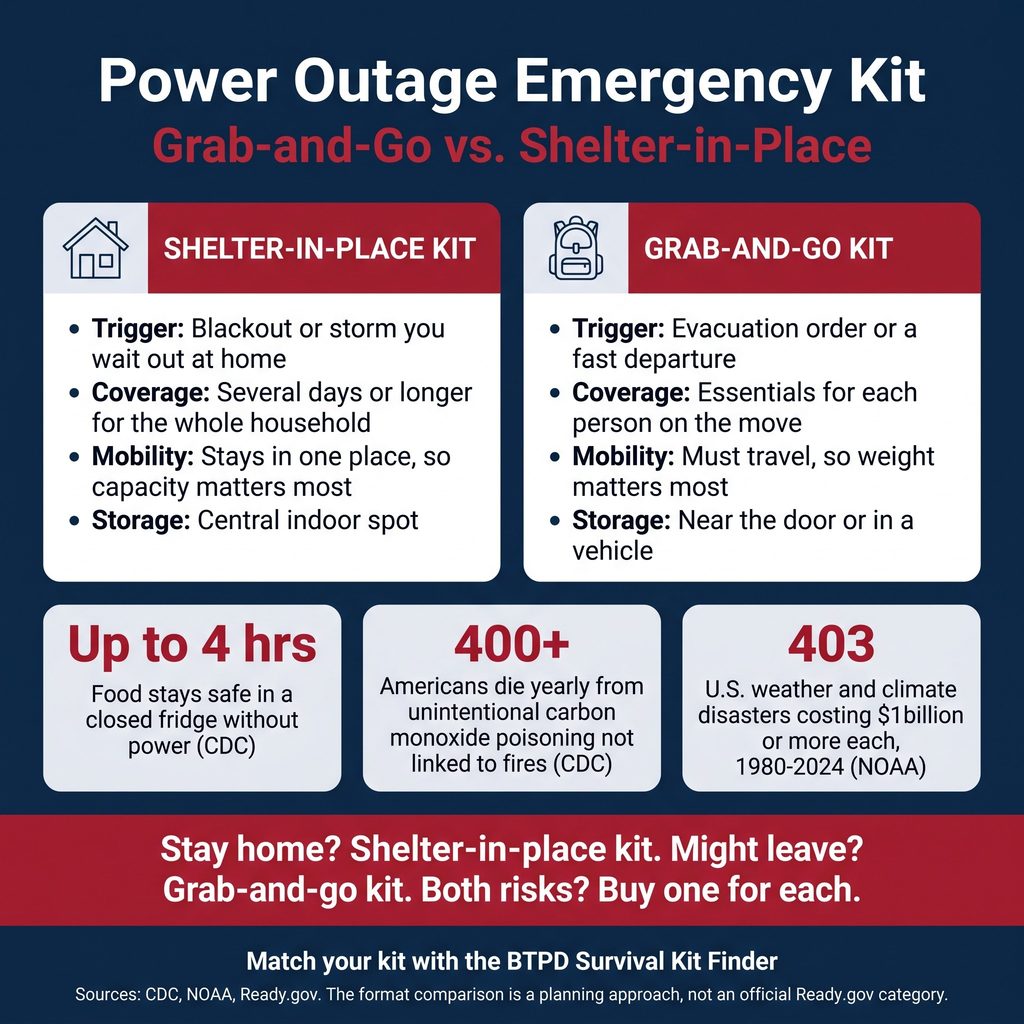
A power outage emergency kit built for staying home holds more, while one built for leaving trades capacity for speed.
Side-by-Side Comparison Table
This table reflects a planning approach, not an official Ready.gov category.
| Criterion | Shelter-in-place kit | Grab-and-go kit |
| Trigger | Blackout or storm: you wait out at home | Evacuation order or a fast departure |
| Coverage | Several days or longer for the whole household | Essentials for each person on the move |
| Mobility | Stays in one place, so capacity matters most | Must travel, so weight matters most |
| Group size fit | Scales up for families, offices, and schools | Sized per person or per vehicle |
| Storage | Central indoor spot | Near the door or in a vehicle |
Ready.gov tells you to prepare to survive on your own for several days, and it suggests keeping a work kit in a “grab and go” case.
How to Read the Table
Start with the Trigger row, because it decides every other row. If the trigger is a blackout, you ride out at home; capacity matters more than weight. If the trigger is an evacuation, weight and speed matter more than capacity.
BTPD matches each power outage emergency kit to your emergency type, group size, preparedness level, and kit format, so you buy only what your situation requires.
Buy a shelter-in-place kit if you will wait out a blackout at home. Buy a grab-and-go kit if a storm may force you to leave. Size either one to your group and the days you must cover. If both situations apply, plan on two kits, one for each trigger.
How the Survival Kit Finder Narrows Your Choice
A reliable supplier helps you match a kit to your actual needs instead of recommending the same kit for everyone. The BTPD Survival Kit Finder works that way. You pick your emergency type, group size, preparedness level, and kit format, then see matching products.
For a second check, try the BTPD Home Emergency Readiness Assessment. Its 24 questions across six readiness areas produce a PDF action list based on FEMA and Ready.gov guidance. The assessment does not certify that your home is safe.
One Trigger, One Layer: Why Outages and Evacuations Need Different Kits
An outage and an evacuation start from different triggers, so each needs its own layer. Your shelter-in-place layer protects you at home.
CDC reports that more than 400 Americans die each year from unintentional carbon monoxide poisoning not linked to fires. CDC also warns you against running generators, grills, or other fuel-burning devices inside your home, garage, or carport.
CDC states that food stays safe up to four hours in a closed refrigerator without power. After that window, your stay-home kit should rely on shelf-stable supplies.
Your grab-and-go layer covers the storm that sends you out the door. NOAA’s National Centers for Environmental Information confirmed 403 U.S. weather and climate disasters with losses of $1 billion or more each from 1980 through 2024. Count the people and days for each layer separately.
Quotes, Shipping, and Returns for Households and Groups
Professional and group buyers should ask how fast a quote arrives and whether the order ships in bulk. BTPD offers fast quotes and bulk delivery through its RFQ form, and a team member replies within one to two business days.
Shipping runs standard, expedited, or overnight, and standard typically takes five to seven days. Orders outside the lower 48 states go through a special quote. You can return an item in its original condition within 30 days for a full refund.
Your power outage emergency kit needs water, food, and medicines first, then lighting, communication, and first aid.
The Government Baseline
Ready.gov’s emergency supply list recommends water and non-perishable food for several days, a battery-powered or hand-crank radio, a flashlight with extra batteries, a first aid kit, and an extra phone battery or charger. Use that list as your floor, then adjust it for infants, pets, and medical needs.
Shelter-in-Place Kit Contents
Stock shelf-stable food, water, and medicines for every person in the group. Add light and communication, since BTPD carries flashlights and walkie talkies. Include a medical kit and a fire blanket, both listed under BTPD’s Emergency Preparedness & Survival products.
Grab-and-Go Kit Contents
Pack the same categories in a smaller footprint, with one bag per person or per vehicle. Keep it near the door so you can leave within minutes. Add a flashlight, a medical kit, and a compact radio or earpiece for communication.
Weight and duration separate a power outage emergency kit built to stay from one built to go.
Difference 1: Weight and Mobility
Yes, a grab-and-go kit moves faster, but that speed means it carries fewer supplies. A shelter-in-place kit carries more because it never travels. Decide first whether you will carry the kit or leave it in place.
Difference 2: Duration and Capacity
A shelter-in-place kit covers more days, but it only helps while you stay put. A grab-and-go kit covers the first stretch away from home. Before you choose, count how many people and days each kit must cover.
The right power outage emergency kit depends on where you will be when the lights go out and how many people you must cover.
Best for Shelter-in-Place Buyers
Choose a shelter-in-place kit if you manage a household, office, or school that expects to wait out multi-day blackouts at one location. You need lighting, food, water, and medical supplies for the whole group.
Best for Grab-and-Go Buyers
Next, choose a grab-and-go kit if you live in a storm-prone area and may leave within minutes. You need essentials for each person that fit in a bag or vehicle.
Best for Buyers Who Need Both
Finally, buy one kit for each trigger if your household faces blackouts and evacuation-level storms.
Q1. Is one emergency kit enough for both a power outage and an evacuation?
One kit rarely covers both. A stay-home kit holds supplies for the whole household for several days. An evacuation kit must be light enough to carry out the door in minutes. Buying one kit per trigger covers either case, and the Survival Kit Finder helps you size both.
Q2. How many days should a blackout kit cover?
Plan for several days at minimum, in line with the Ready.gov guidance above, then add days if your area faces long storm outages. Add people to the count before you add days.
Q3. Can BTPD help me choose a kit size for my group?
Yes. Use the Survival Kit Finder to filter by group size and preparedness level. If you still need help, contact BTPD for preparedness help at 855-741-FLAG (3524).
Q4. Does BTPD ship emergency kits outside the lower 48 states?
Orders from outside the lower 48 states go through the RFQ form for a special quote. BTPD also ships internationally on request.
Choosing a power outage emergency kit starts with your trigger.
If you stay home through blackouts, start with a shelter-in-place kit sized to your household. If storms may push you out, add a grab-and-go kit for each person or vehicle. Veteran-owned BTPD backs both with Trusted Support, fast quotes, and a 30-day return policy.