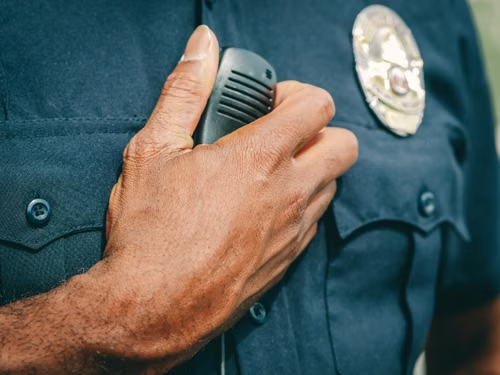
Picture two agencies ordering a police radio earpiece for every patrol officer. One agency checks each radio’s make and model first. The other bases its decision on price alone and skips that check. Gear chosen without checking fit can fail to match the radios you own, which can lead to unnecessary delays.
This article helps you compare:
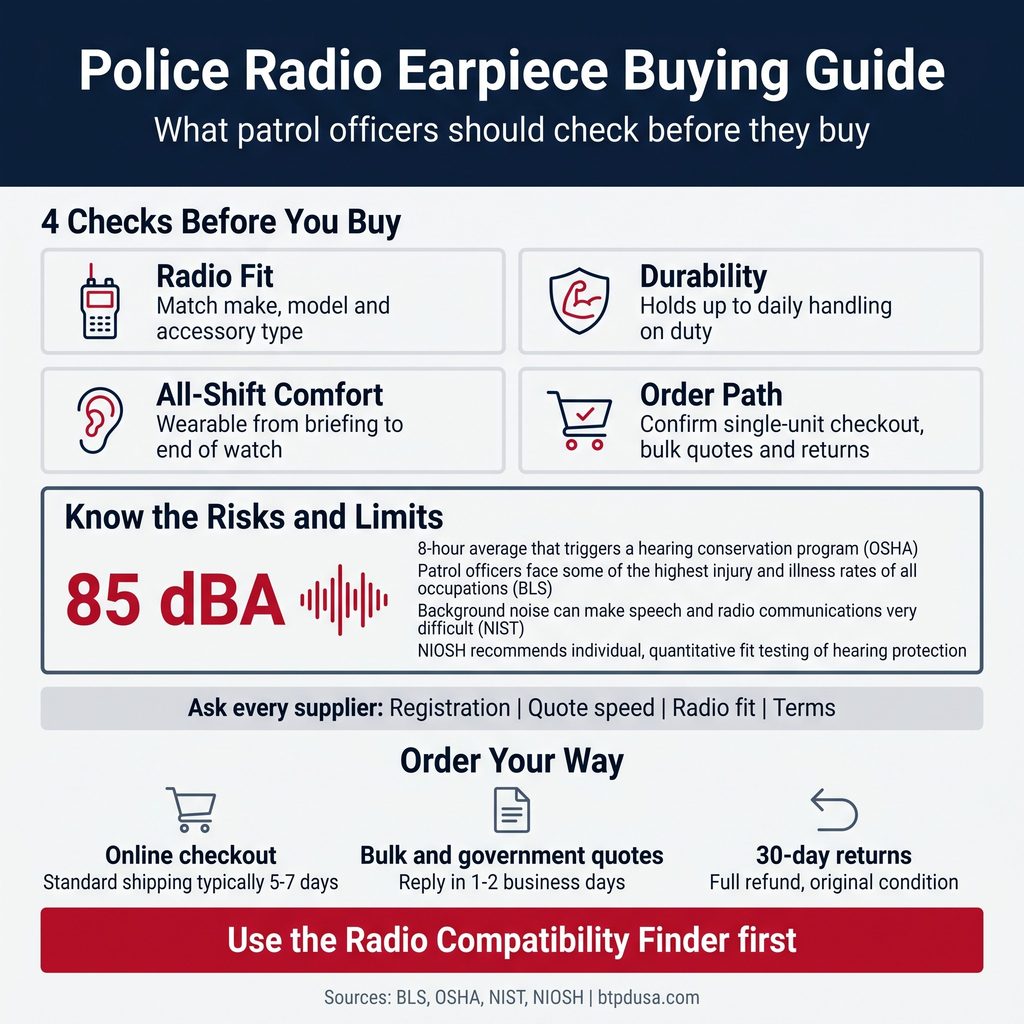
A police radio earpiece suits patrol duty when it fits your radio, survives daily handling, and stays comfortable all shift. Four checks keep your shortlist honest.
Four Checks Before You Buy
Patrol work puts gear under real strain. The Bureau of Labor Statistics reports that police and sheriff’s patrol officers, along with transit and railroad police, have some of the highest rates of injuries and illnesses of all occupations. Reliable communication gear is therefore a practical safety decision.
A reliable supplier helps you confirm radio compatibility and clearly explains its quoting, bulk ordering, shipping, and return terms. Compare every option on these four checks:
The best police radio earpiece for a patrol officer fits your radio’s make and model, holds up to daily wear and stays comfortable for a full shift. Confirm radio compatibility first, then compare build quality and comfort.
The Radio Compatibility Finder matches accessories to your radio by make, model, and accessory type, so you can check fit before you order.
1. Pick One: For Everyday Patrol Wear
Choose this option if you wear an earpiece through every shift. Look for a secure, comfortable fit and sturdy construction. Check the radio fit before you order. Then add it to your cart and check out as a guest or with an account.
2. Pick Two: For Long Shifts and Overtime
Choose this option when comfort over many hours matters most. Compare how each design sits in the ear and how it connects to your radio. Radio not listed? Contact the support team for compatibility help.
3. Pick Three: For Department-Wide Standardization
Standardizing one model across your team simplifies training and replacement. Confirm that it fits every radio model your officers carry. Then request a bulk quote through the RFQ form.
4. Pick Four: For Government and Agency Purchasing
Agency buyers need clear quotes and delivery terms. This supplier lists fast quotes and bulk delivery for government orders. Request a government quote, and match each earpiece to the radios, officers, and vehicles it will serve.
A police radio earpiece should fit your shift length and noise exposure as well as your radio. Your agency’s schedule may differ from a 12-hour pattern, so check it first.
What the 85 dBA Threshold Means for You
OSHA’s occupational noise exposure standard, 29 CFR 1910.95, requires a hearing conservation program whenever employee noise exposures equal or exceed an eight-hour time-weighted average of 85 decibels.
OSHA’s bulletin on hearing protector fit testing adds that repeated exposure at 85 dBA or higher is considered hazardous, that workers must still hear communication and warning signals while wearing hearing protection, and that requirements in OSHA-approved State Plans may vary from federal rules.
If your shifts run longer than eight hours, ask your agency’s safety officer to assess your total noise exposure and determine which requirements apply to your department.
Hearing, Radio Clarity, and Your Earpiece Choice
The National Institute of Standards and Technology reports that background noise during public safety operations can make speech and radio communications very difficult. Test audio in your own conditions before you standardize on one model.
NIOSH recommends that employers use individual, quantitative fit testing to evaluate the attenuation workers receive from their hearing protection devices.
If your agency issues hearing protection, ask your safety officer about fit testing, and choose an earpiece you can wear comfortably alongside it. Treat earpiece selection as a communication decision, and rely on your safety officer for hearing protection guidance.
Before you buy any police radio earpiece, confirm your radio’s make and model, then put four questions to every supplier.
Check Your Radio in the Radio Compatibility Finder
Choose your radio make, model, and accessory type to see compatible products. Radio not listed? Contact the support team for compatibility help. Skipping this step can leave you with gear that does not match your radios.
Ask every supplier the same questions. Use this list when you compare quotes:
Ordering a police radio earpiece here works two ways: online checkout for individual officers or a quote request for agencies.
Online Orders for Individual Officers
Browse the catalog, add items to your cart, and pay by credit card, PayPal, and more. Standard shipping typically takes five to seven days, and expedited and overnight delivery are also available. You receive a tracking link by email.
Bulk and Government Quotes
If you buy for an agency, send a request through the form at btpdusa.com/rfq. The supplier states that its support team helps you find what you need and that it offers Government Contracts Simplified as a veteran-owned, SDVOB company.
Q1. How do I know if a radio earpiece fits my police radio?
Check your radio against the Radio Compatibility Finder before you order. The tool lists compatible products once you enter your radio details, and the support team helps if your radio is missing. A quick check stops you from buying an earpiece your radio cannot use.
Q2. How fast can I get a bulk quote for radio earpieces?
Submit the form at btpdusa.com/rfq. A member of the team reaches out within one to two business days. Government buyers can also request a government quote, and bulk shipping is available.
Q3. Does this supplier ship radio earpieces outside the lower 48 states?
Yes. Orders outside the lower 48 states and international orders go through the special quote form. Submit your request at btpdusa.com/rfq, and the team will quote on request.
Q4. What is the return policy on radio earpieces?
Return an item within 30 days for a full refund, as long as it is in its original condition. If an item arrives damaged, contact support for a replacement or return.
Q5. Is this supplier SAM registered and GSA eligible?
The supplier states that it is SAM Registered and DUNS Verified and GSA and Set-Aside Eligible. Those are the supplier’s own claims, so confirm which registrations apply to your purchase during the quote process. It is also veteran-owned and SDVOB.
The right police radio earpiece matches your radio, survives daily wear, and stays comfortable through your whole shift.
Start with fit, because a mismatched order costs you time you do not have. Then request a quote or add your selected earpiece to the cart. BTPD USA’s motto, “Your Shield in the Field,” reinforces its focus on mission-ready gear and customer support.