
A Navy SEAL just insulted me. Not to my face—in a book he wrote.
One sentence made me realize my water storage is about as useful as a screen door on a submarine.
And the worst part?
I soon found out he was right.
On Chapter 4, Page 47 he writes:
“If you’re storing water to prepare for disasters, STOP. You’re not preparing to survive—you’re preparing to die slowly.”
I have 80 gallons worth of water in my shed.
I’ve been rotating stock for three years. I have a spreadsheet. I’m organized. I’m PREPARED.
And this guy—who survived Ramadi, who’s dealt with water sources I can’t even imagine—is telling me I’m doing it wrong?
I picked the book back up.
I’ll be honest. My first reaction was defensive.
Why?
Because even though I don’t really consider myself one of those “preppers”, I’m still a responsible parent. I’ve still read the guidelines.
CDC says one gallon per person per day…
FEMA says 72-hour minimum…
And I’ve got 20 days for my family of four.
I’ve done everything right.
Haven’t I?
The SEAL opens Chapter 4 like this:
“Everyone I meet has the same setup: a garage full of water jugs, a basement stacked with cases, but when disaster actually hits… most of them fail anyway.”
I’m reading this thinking, “Okay, so what am I supposed to do differently? Store MORE water?”
That’s when the next paragraph said this:
“You’re not storing survival. You’re storing a countdown timer. And the clock is already ticking.”
That line stopped me cold.
He walks through three real disasters in the book.
Hurricane Helene, 2024.
“Over 100,000 people evacuated from Western North Carolina. Do you know how much of their stored water they brought with them?”
He gives the average: 6 bottles per family.
Not 60 gallons. Not even 6 gallons.
6 freakin bottles.
“Because water is 8.3 pounds per gallon. When you’re evacuating at 3 AM with rising water and screaming kids, you’re not loading 500 pounds of water jugs into your Honda Pilot. You’re grabbing what fits in ten seconds and leaving the rest.”
Before I could keep reading, I walked to my shed. 2:17 AM now.
I turned on the light and looked at my 80-gallon, 664-pound stockpile.
If we had to evacuate right now—and sirens were blaring, with fifteen minutes to load the car—how much of this could I actually take?
I started doing the math in my head.
Kids’ bags. Documents. Medication. Photo albums. Sarah’s work laptop. Food. First aid kit.
Maybe I could fit 20 pounds of water. Two and a half gallons.
For a family of four.
All that prep. All that weight. All that shed space.
And in the one scenario where we’d need it most, I could take less than 3%.
I went back inside and kept reading.
The SEAL listed his next example:
Texas freeze, February 2021.
He writes: “Fourteen million people went without power during this freeze. Millions had water stored, but it didn’t matter.”
He explains why.
“Treatment plants went offline, which means pumping stations failed. Even if you had storage, the crisis outlasted it. The average stored supply was 5-7 days, but the actual duration of this water infrastructure failure lasted over 3 weeks.”
The SEAL’s point: “Storage is a countdown. It WILL run out. Then what?”
Paradise, California wildfire, 2018.
“The entire town evacuated. The average warning time was 12 minutes while the average weight of people’s water storage was 200-400 pounds.”
“The percentage of families who successfully evacuated their stored water was less than 3%.”
Which means 97% of people’s prep during this faster was as useful as no water at all.
That made me feel sick.
Because the SEAL was right.
Every scenario I’ve been prepping for has the same fatal flaw: I assumed my storage would still be accessible when I needed it.
But what if I CAN’T access it?
Evacuation forces me to leave storage behind.
Extended outages are outlasting storage now more than ever.
Infrastructure failures make it run out before help arrives.
My 80 gallons only works in ONE narrow scenario: Staying home for 20 days or less with no complications.
But for the 90% of other scenarios—I’m exposed.
More importantly, my entire family is exposed.
I sat there picturing it. Grid down. Taps dry. My kids looking up at me asking for water.
And me having to say: “We left it in the shed.”
The idea of my kids thirsty and me helpless—that’s what actually keeps me up at night.
I kept reading.
I’m so glad I didn’t go to sleep that night and forget about the book.
Because finally… the SEAL said something that changed my perspective on being prepared forever.
Chapter 4, Page 51.
The SEAL explains what the military does instead.
“In Ramadi, we faced the same problems preppers face—just in extreme form.”
“We couldn’t carry enough water. Weight kills you in combat. A week’s worth of water? That’s 50 extra pounds that gets you killed.”
“We couldn’t rely on resupply. Convoys got delayed. Sometimes for weeks. Our ‘storage’ ran out and help didn’t come.”
“And we never knew when we’d have to move fast. Ambush, building collapse, repositioning—you have 60 seconds to grab your gear and go. You’re not hauling water jugs.”
“So we stopped trying to store water. We stored the CAPABILITY to create water instead.”
He describes what they used.
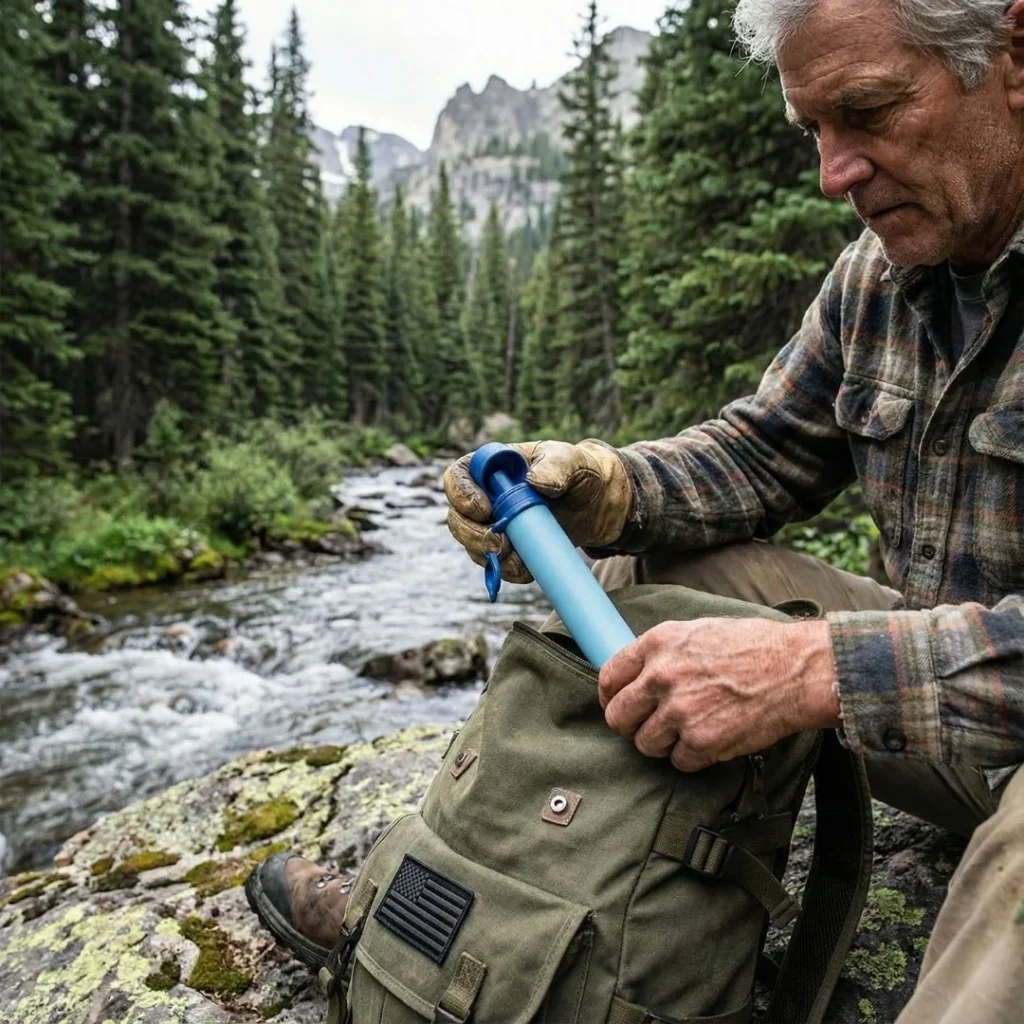
“Portable water filters. Hollow fiber membrane. Each one weighs two ounces and filters 400 gallons from any source.”
“Creek water. Mud puddles. Livestock troughs. Irrigation canals. Didn’t matter. We had unlimited water anywhere we went.”
“Weight problem? Solved. It’s 2 ounces.”
“Duration problem? Solved. 400 gallons from any source means you never run out.”
“Mobility problem? Solved. Fits in your pocket. Goes wherever you go.”
Then this line:
“Preppers store water. Soldiers store access to water. Guess which one survives longer?”
I read that three times.
Storage is weight. Storage is volume. Storage is a countdown.
Access is capability. Access is mobility. Access is unlimited.
He breaks down how the filter actually works. I’m reading this like I’m back in school taking notes.
Hollow fiber membrane technology. Filters down to 0.1 microns.
Bacteria are 0.2 microns at minimum. They physically cannot pass through.
Four stages: hollow fiber membrane, activated charcoal, two layers of PP cotton.
Removes 99.999999% of bacteria. 99.999% of parasites.
Makes ANY water source safe to drink.
Pond water. Creek water. Lake water. Rain barrel water. Any freshwater source around you is instantly accessible. Even toilet tank water in emergencies.
Then he writes:
“With one 2-ounce filter, you have access to thousands of gallons around you that you couldn’t safely drink before. That’s not prep. That’s survival.”
Sat there at my kitchen table. 2:47 AM.
I thought about my 80 gallons in the shed.
It’s not necessarily WRONG, it’s just incomplete.
Because if we evacuate, 80 gallons are useless. If we stay put—but infrastructure fails for longer than three weeks? 80 gallons are useless.
So I pulled out my phone and looked up what the SEAL recommended in the book:
The HYDRA-X1 Emergency Water Filter.
It’s got the same hollow fiber membrane system the military uses. Four-stage filtration. 0.1 microns so bacteria, parasites, and microplastics can’t pass through. 400-gallon capacity.
And it only weighs 2 ounces.
I read that spec again. Two ounces.
My 80 gallons: 664 pounds.
This filter: 2 ounces.
My storage: 400 gallons maximum if I kept buying and rotating forever.
This filter: 400 gallons from ANY SOURCE without storing a drop.
See the difference?
One of the traps you. The other one can save your life.
I ordered it at 3:04 AM. After reading that guide, I physically couldn’t sleep until I did.
The package arrived Thursday. I opened it at my kitchen table. My wife Sarah thought I was being ridiculous.
“You ordered another prep thing at 3 in the morning?”
“Just trust me on this one.”
The filter was smaller than I expected. About the size of a highlighter. Weighed nothing. I filled a water bottle from the tap. Screwed the filter onto the top.
I drank.
It tasted like normal water. Clean. No weird aftertaste. Nothing.
Sarah was watching. “What is that?”
“Water filter. The book said to test it before we ever need it. Make sure it actually works.”
“Test it on WHAT?”
So Saturday morning, I took the filter to the retention pond down the road. Sarah followed me outside and said, “You’re not drinking dirty river water.”
“The SEAL said any freshwater source.”
I screwed the filter on and drank half the bottle.
Sarah just stared at me. “You’re insane.”
“Give it 24 hours. If I’m fine, it works.”
So Sunday morning rolled around. I felt completely normal. No stomach issues. Nothing.
And that’s when I knew what the seal meant.
I wasn’t carrying 664 pounds of storage.
I was carrying 2 ounces of ACCESS.
It’s been eleven days since I read Chapter 4. I’ve got filters in both cars now. One in each of our go-bags. Two extras in the hall closet.
The 80 gallons in the shed? Don’t get me wrong, it’s still there. I’m keeping it. But I understand it differently now.
Storage is for staying home. For the first few days. For convenience.
But the filter is for everything else. For evacuating. For extended crises. For mobility. For when storage runs out and infrastructure is still down.
I went back and reread that chapter last night.
The SEAL ends it like this:
“You can keep preparing the way everyone tells you to. Stack water. Rotate stock. Follow the guidelines. And when disaster hits, you’ll have exactly what those guidelines give you: A short countdown and no options after.”
“Or you can prepare the way people who actually survive disasters prepare. Store some water for convenience. But store ACCESS to water for survival.”
“One of those keeps you alive for two weeks. The other keeps you alive indefinitely.”
“Choose accordingly.”
I chose.
The filter is called the HYDRA-X1. Same system the SEAL recommends. Same tech the military uses in field operations and humanitarian organizations deploy in disaster zones worldwide.
Four-stage filtration. Hollow fiber membrane. 0.1 microns. Removes 99.99% of bacteria and 99.99% of parasites.
Weighs 2 ounces. Filters 400 gallons. Fits in your pocket.
I got mine here:
https://try.primitivelabsresearch.com/cmlzrfdnm022zm3cxh2…
They have a family pack option with five filters. That’s what I ordered the second time. One for each family member and extras for the cars and house.
Not because I’m paranoid. Because I finally understand what ACTUAL preparedness looks like.
It’s not how much you store. It’s what you can access when storage fails.
The Navy SEAL was right.
Storage is a countdown timer.
But access is survival.
Choose accordingly.